
Call us today!
+(92) 51 111-111-028
We are open!
Mon-Fri 8:30-04:30
Analysis of Physiological Signals for Emotion Charting
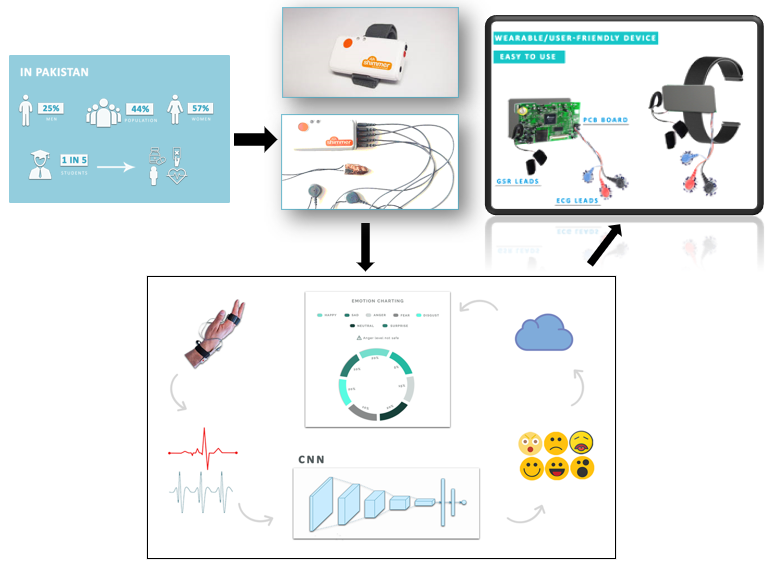
Several studies have proved that emotional health has direct impact on humans physical and psychological health. Globally there are more than 300 million and about 260 million people are suffering from depression and anxiety respectively. A survey from World Health Organization (WHO) found that these types of disorders causes $1 trillion annual loss of productivity. Various emotion recognition devices have been developed in the past incorporating facial expressions, body postures and speech recognitions. The accuracy of the devices is dependent on the expressiveness of the user himself and can be fairly manipulated so the need of the time is a solution that provides highly credible emotion classification of humans without possible manipulation and user participation. The goal of this project is to classify the emotions to maximal accuracy. Emotion charting using physiological signals has increasingly become a hotspot and developing trend in the fields of affective computing and human computer interface. Interest in this field has been motivated by the unbiased nature of physiological signals, which are generated autonomously from the central nervous system. Generally, these signals can be collected from cardiovascular system, respiratory system, electro dermal activities, muscular system and brain activities. Electrocardiogram (ECG), Electroencephalogram (EEG) and Galvanic Skin Response (GSR) are proved to be effective means of detecting emotions. We extract the ECG, EEG and GSR signals from human body using shimmer sensors and is used for classifying into seven basic human emotions (happy, fear, sad, anger, neutral, disgust and surprise). This work incorporates combination of feature engineering techniques using signal processing with deep learning techniques like “Convolutional Neural Networks” for emotions classification. This would be a step towards development of real time emotion charting devices for diagnosing and providing better treatment to people dealing with emotional disorders.